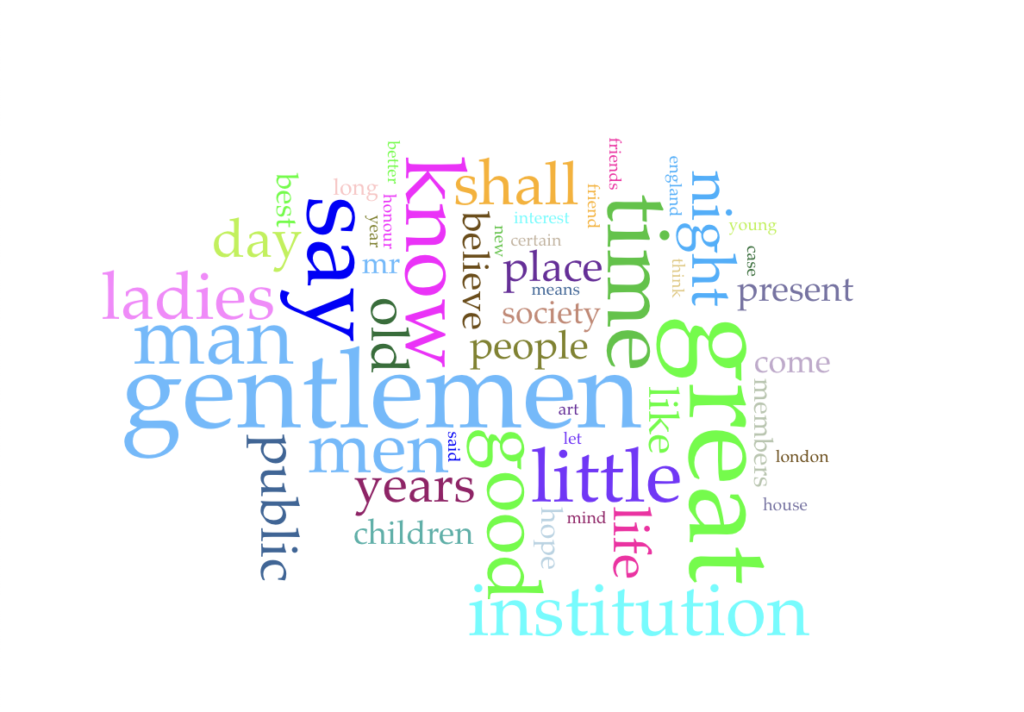
Above is a cirrus visualization of the top 55 most used words in Dickens’s corpus, however the most common English words such as “the,” “of,” and “and” are removed from analysis. Therefore, this cloud shows a more precise depiction of Dickens’s writing as compared with English text in general. It’s easy to see which words are most common at a glance, with “great” at the top of the list. Unsurprisingly, both “ladies” and “gentlemen” are high on the list, as many speeches begin with those two words. It’s worth noting, though, that “gentlemen” is much more common. This observation led me to explore the gender discrepancy in Dickens’s speeches.
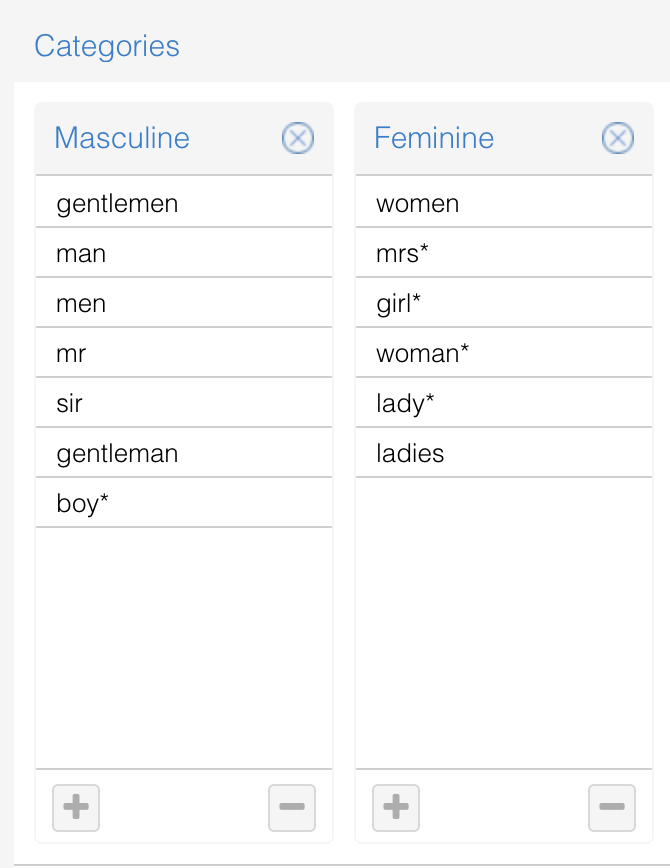
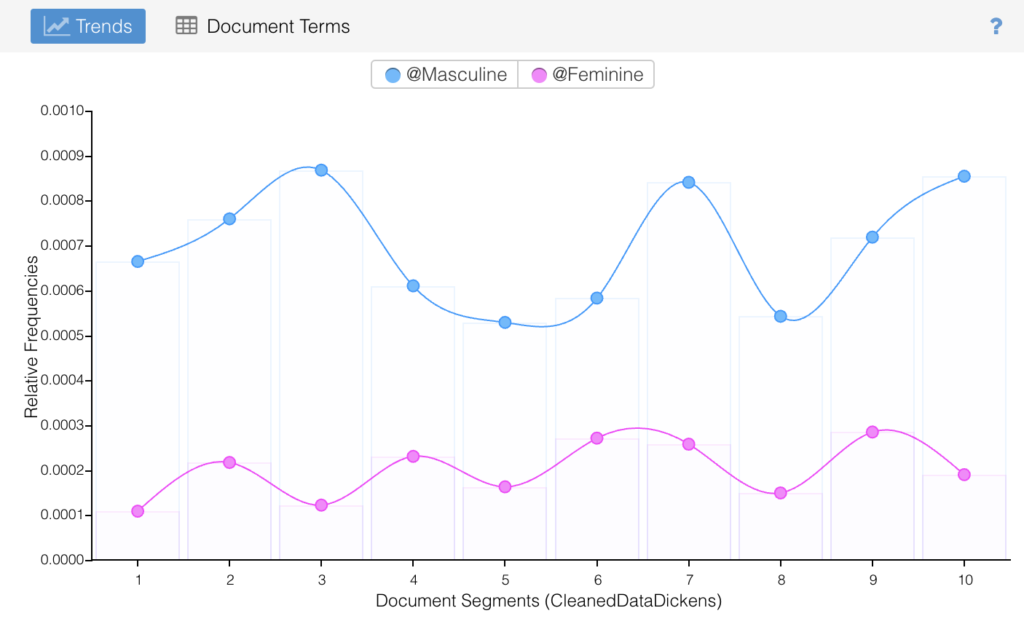
I started by using Voyant Tools‘s “categories” function to group words that correspond with men and with women. I looked through common terms and included each relevant word I found as well as its counterpart. (Interestingly, neither “madam” nor “ma’am” appear anywhere in Dickens’s speeches, so there is no listed equivalent to “sir”.) I then graphed the frequencies of masculine terms and feminine terms over the course of each section of the corpus. It’s immediately obvious that mentions of men outnumber mentions of women in for the entirety of Dickens’s speeches. Despite significant fluctuations, it’s never even close. While it might be rash to necessarily condemn Dickens himself for this discrepancy, it’s important to recognize the difference as representative of societal disparities at the time. It would be interesting to see if a corpus of modern speakers displays the same bias.
Data can only be feasibly analyzed like this within the field of Digital Humanities. The traditional humanities discipline is obviously capable of exploring the gender biases of a certain author, but by digitizing this project, we can synthesize a far more concise and data-driven depiction of Dickens’s work. Similarly, mere data science lacks the wider implications of such a visualization. Not only does Digital Humanities allow us to quickly explore vast corpuses of text, but we are pushed to explain those corpuses as well. This project should stand as proof of the value of combining literary and computational disciplines into one pioneering field.
